Geometry Dash: Zrist is not just another clone in the dash universe. While it looks like a simple black-and-white platformer, it hides a level of complexity that will catch most players off guard. If you think you've mastered the rhythm genre, this game is here to prove you wrong.
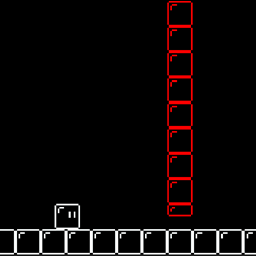
The core of Zrist is simple but demanding. Unlike the standard just jump mechanics, you have two primary actions: Jump and Slide. You use the Left Click (or X) to hop over gaps and the Right Click (or C) to slide under low-hanging red blocks. The game moves fast. One wrong click ends your run instantly.
What truly sets this game apart, and what most casual players miss, is the Next Rule system. The game doesn't just get faster, it changes the laws of physics on the fly.
These mechanics make Zrist feel more dynamic than Geometry Dash Robot, where the challenge is usually about steady flight. In Zrist, the challenge is about surviving chaos.
The high-contrast, black-and-white aesthetic isn't just for style. It's a functional choice. By stripping away the flashy neon lights of other dash games, Zrist forces you to focus entirely on the red danger zones. It's pure, raw gameplay. You either adapt to the changing rules, or you fail.
Most veteran players consider the Lag rule the most difficult. It intentionally disrupts your muscle memory, requiring you to predict obstacles rather than reacting to them in real-time.
The key is to look ahead. When the "Memory" rule appears, ignore the cube for a second and stare at the right side of the screen. Try to count the gaps before the map becomes a trap.
Yes. Since Zrist uses a simple two-input system, it is perfectly optimized for mobile browsers. You tap the left or right side of the screen to control your character's movements.